ב"ה


Chassidism requires us to fulfil our G-dly mission proudly regardless of how it might affect our own growth. In fact, spreading G-dliness to those around us will most certainly impact us positively as well. It’s our responsibility to do what is required of us to transform the world positively. As for the sense conceit that it can possibly impart in us along the way, that can always be rectified through the fire of Torah and mitzvos.

The Month of Elul
Chassidus teaches that throughout the month of Elul the Almighty is “unusually accessible” to every Jew as He displays “a smiling countenance and receives everyone with grace and favor.” Then, why are we not enjoined to be joyous?! In answering the question, this talk addresses the obligation to educate children, and reveals a unique kind of joy that lies at the core of the preparatory days of Elul. (Sefer HaSichos 5748, Shoftim)


This class introduces the mitzvah of the mezuzah, highlighting both its spiritual significance and its protective powers. The lesson details the precise requirements for creating a kosher scroll, covering everything from the preparation of the parchment and ink to the specific script styles and the need for a trusted and expertly trained scribe.





The Month of Elul
Chassidus teaches that throughout the month of Elul the Almighty is “unusually accessible” to every Jew as He displays “a smiling countenance and receives everyone with grace and favor.” Then, why are we not enjoined to be joyous?! In answering the question, this talk addresses the obligation to educate children, and reveals a unique kind of joy that lies at the core of the preparatory days of Elul. (Sefer HaSichos 5748, Shoftim)


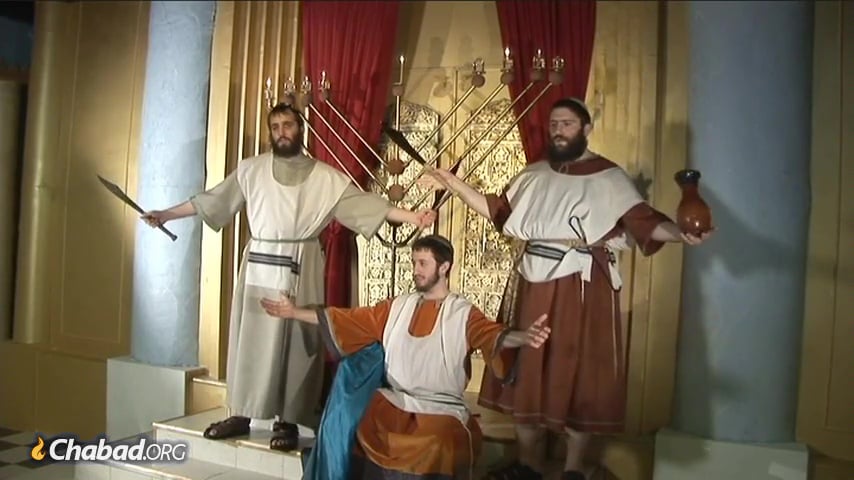



Smashing Idols
The famous story from the Midrash about how Abraham destroyed the idols in his father's shop. An excerpt from the full DVD “Young Abraham”.


Does G-d pay His workers on time?
The Torah commands that a laborer's payment not be withheld even a day. G-d Himself, our Sages tell us, observes the very commandments He obligates us to fulfill. How then does G-d not immediately reward man for his/her service of Him, deferring man's reward to the 'World to Come'?! (Likutei Sichos, Ki Teitzei volume 29)


Learn about the mitzvah of Maakah—to construct a fence around a rooftop to protect against a hazard. Discover an interesting exception to this obligation and the reasoning behind it as we compare and contrast different situations, and in the end, apply their spiritual dimension to our life. (Based on Likutei Sichos vol. 24 Ki Seitzei sicha 2)


Learning Likutei Sichos vol. 19, Ki Seitzei sicha 1
The mitzvah of sending away the mother bird from amid its young is associated with the reward of long life. We examine the Siyum (conclusion) of tractate Chullin and look to reconcile conflicting teachings regarding whether there is reward for a mitzvah in this world.







Chana’s Prayer and Rosh Hashanah
On Rosh Hashana we read in the Haftorah about the birth of the prophet Samuel. Childless for many years, one year on Rosh Hashana, his mother Chana offered a prayer that elicited the Divine blessing resulting in his birth. The Talmud states that Chana's prayer is the model which all prayer aught emulate. This class will explain how to access the awesome power of prayer any time and especially on Rosh Hashana. (Likutei Sichos vol. 29, p.182)


Get the Chabad.org Video app